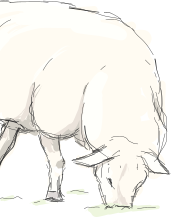
We run two flocks of sheep to ensure a continuous supply of lamb. We have 150 Poll Dorset cross Mule ewes which are able to be mated outside of the normal Autumn season to start lambing at the beginning of January, thus providing new season Easter lamb. They are lambed indoors and turned out to grass a few weeks later when the weather is kinder.
The later lambing flock of 600 ewes is comprised of a longstanding commercial cross breed, the Mule, and continental type breeds which will provide a good meaty lamb. These lamb at the more traditional time of March- May when there is plenty of goodness in the grass and the lambs benefit from some kinder weather. The lambs are weaned from their mothers at 3 months of age when they will be given the best grazing.
Sheep were first farmed over 10,000 years ago, and now there are more than 40 million sheep in the UK that provide wool and meat. Around 20 million of the sheep are breeding ewes.
Environment
Sheep live outdoors. They are herbivores, they eat grass and other plant material in the field. Sheep are happy to live outside all year round. However, the shepherd will bring the ewes in 3 – 4 weeks before lambing so that they can keep a close eye on them.
Breeding
Unlike many other animals, sheep are seasonal breeders and lamb in the spring months when the weather is warming up and there is a good supply of grass. Sheep can be housed for lambing or brought to a fild close to the farmyard where the shepherd can keep an eye on them.
Ram (male sheep), Ewe (female sheep, Gestation period (pregancy)of a ewe is 5 months (147 days)Ewes may carry between 1 and 3 lambs.
Lambing Time
The first signs of lambing comes when the ewe leaves the rest of the flock and finds a quiet location in which to lamb. Within a hour or so, labour will start. When the ewe is in labour she may stand and paw the ground searching for a lamb.
Environment
The sheep live outside in the fields all year around. Sheep are herbivores and so eat grass and other plant material in the field. They have thick wool coats which keep them warm. Wool contains Lanolin which feels greasy, this helps keep the sheep dry. Lanolin is used to make lipstick and hand creams.
January
The main flock of ewes are scanned for pregnacy. This tells the shepherd if the ewe is pregnant and how many lambs she is carrying. The shepherd sorts the ewes into groups according to how many lambs they will have. The ewes are now given extra food supplements such as wheat, barley and oats. These are high in protein which the ewe needs as it nears lambing. The amount of extra food depends upon how many lambs she is carrying.
February
During February the shepherd will vaccinate the ewes. This helps build their immune system during pregnancy. The shepherd gradually increased the ewes food during February. Ewes carrying twins or triplets will be fed up to ¾ kg of supplement food a day. Ewes that are carrying single lambs will be fed up to ½ kg per day. The shepherds will bring the ewes in from the field into a barn approximately 3 weeks before lambing. This gives the ewes time to get used to their new environment. In the barn they will be bedded on straw and have hay to eat and water to drink.
April
The ewes will give birth. Once the lambs are born they will be put into a pen alone with their mothers. This is called a 'mothering up' pen. This enables the shepherd to keep a close eye on the ewe and her lambs and stops them from getting mixed up with the rest of the flock. The ewe and her lambs are kept in 'mothering pens' for at least 24 hours after the lambs are born. The ewe and her lamb will then be put into the field where there is plenty of goodness in the grass.
Ewes will finish having their lambs at the end of April. The shepherds will carry on feeding the ewes for about 6 weeks after lambing. This ensures that the ewes have the energy to produce enough milk to feed their lambs.
When the lambs are 6 weeks old the shepherd will worm them. He may also spray the ewes to prevent 'Flystrike'
In June the ewes have their wollen fleeces shorn off. Shearing the ewes help to keep them cool during the summer and can also help prevent Flystrike. The fleeces are rolled up and put into wool sacks which are collect from the farm.
During July the ewes and their lambs are separated from one another. This is know as weaning.
September
The shepherd will prepare the ewes before he puts the rams into the field with them. We check the ewe's teeth, trim their feet and check that they are in good condition not too fat or too thin.
October
The rams are put in the field with the ewes so that they can 'serve' (mate) the ewes. The rams will stay in the field for approximately nine weeks. The ewes breeding cycle last for 3 weeks, therefore there are three opportunities for the ewe to become pregnant. A ewes pregancy lasts for 5 months (147 days)
November and December
The early lambing flock come indoors ready for lambing at the beginning of January.